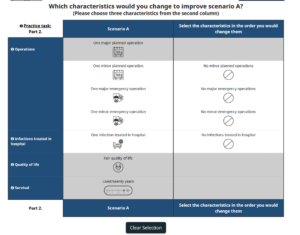
A Kaizen Task™ is a proprietary service in market research that empowers clients to enhance a hypothetical product or service through a sequence of adaptive choices. Under the slogan, “Change that matters”, this process demonstrates the evolution of an object based on client preferences, creating a personalized preference path. Unlike traditional market research methods where clients choose directly between two or more options (e.g., Coke® vs. Pepsi®), a Kaizen Task™ involves iterative modifications to a single object. This innovative approach uncovers deeper insights into what truly matters to clients by capturing more evidence of their preferences than standard pick-one tasks.
Kaizen Task™ is a registered trademark of Benjamin M. Craig, PhD.
Post Office Box in the United States: 701 South Howard Ave, Ste 246, Tampa, Florida, 33606, USA
Physical address in Spain: Av. Olof Palme, 14, 38508 Puerto de Güímar, Santa Cruz de Tenerife, Spain
The Kaizen Task™ is a quick, informative and useful way to inform decisions about product development and evaluation. Buy Now! Contact Benjamin M. Craig at benjamin.craig@r4hpr.org to book a consultation. Kaizen task™ is committed to sustainability, diversity and inclusiveness.
Benjamin M. Craig provides this proprietory service to those interested in market research, specifically in the development and evaluation of products and services from the perspective of their consumers. On this page, we showcase the Kaizen Task™ with an example of a 2021 collaboration with Oxford University, listing articles published in peer-reviewed journals as well as the original grant award.
Case #1 Nuffield Department of Population Health, National Perinatal Epidemiology Unit (NPEU), University of Oxford, Oxford, UK
For this project, 253 people with lived experience of childhood surgical conditions, 114 health professionals caring for children with surgical conditions and 753 members of the general population completed a survey with Kaizen Task™. This preference evidence summarizes how successfully children with surgical conditions have been treated at hospitals across England and Scotland, and can therefore be used to compare hospitals’ observed and expected outcomes. This information is essential for identifying and reducing unwarranted variation in management and outcome.
Reference:
Craig BM, Jumamyradov M, Rivero-Arias O. The Performance of Kaizen Tasks Across Three Online Discrete Choice Experiment Surveys: An Evidence Synthesis. Patient. 2024 Nov;17(6):635-644. doi: 10.1007/s40271-024-00708-4. Epub 2024 Jul 20. PMID: 39031285; PMCID: PMC11461645.
Rivero-Arias O, Buckell J, Knight M, Craig BM, Ramakrishnan R, Kenny S, Allin B; CSOR Collaborative Group. Defining treatment success in children with surgical conditions. Arch Dis Child. 2024 Apr 18;109(5):377-386. doi: 10.1136/archdischild-2023-326156. PMID: 38135491; PMCID: PMC11041596.
Rivero-Arias O, Buckell J, Allin B, Craig BM, Ayman G, Knight M; CSOR Collaborative Group. Using stated-preferences methods to develop a summary metric to determine successful treatment of children with a surgical condition: a study protocol. BMJ Open. 2022 Jun 9;12(6):e062833. doi: 10.1136/bmjopen-2022-062833. PMID: 35680263; PMCID: PMC9185585.
Craig BM, Kaizen tasks in health preference research, Health Economics Research Centre, Department of Public Health, University of Oxford, Oxford, England, UK. November 2021.
Knight M, Improving unwarranted variation in outcomes of children’s surgery through a new Children’s Surgery Outcome Reporting system using routinely available data (CSOR). UK NIHR127844 (Principal investigator: Knight, M) 01/10/2020-30/09/2025. Total amount paid to Benjamin M. Craig for the Kaizen Task: £ 2,177.431